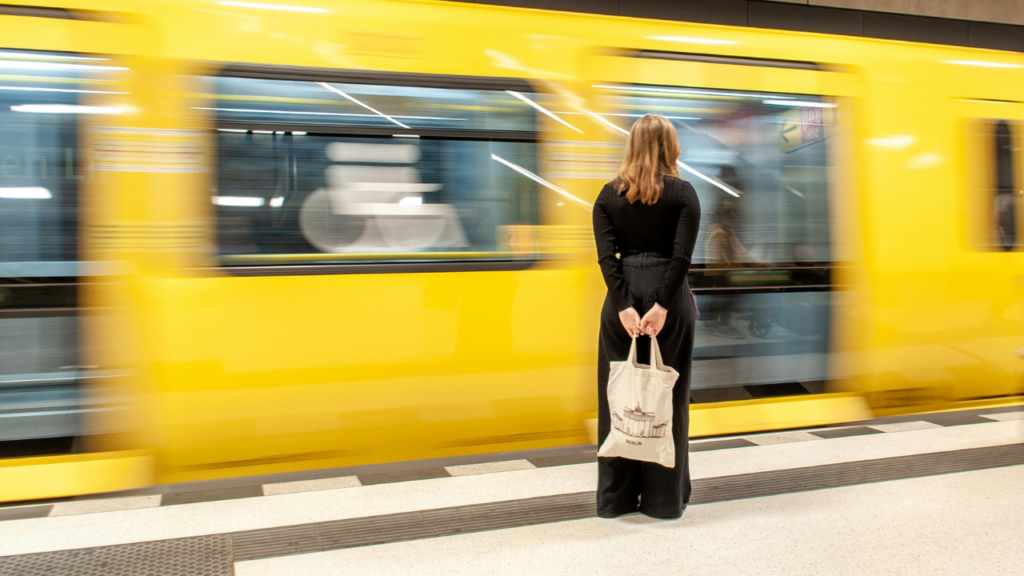
One of my favorite TikTok genres is surprisingly specific.
Students carrying ridiculous objects.
A mattress on a train.
A giant desk rolling through a station.
A bookshelf balanced on a bicycle.
A chair that clearly should not fit through the train doors, somehow made the journey anyway.
The comments are usually full of the same question:
“How are they not embarrassed?”
The first time I saw these videos, I wondered the same thing.
Not because the objects looked heavy.
Because the people looked completely unconcerned.
Nobody seemed worried about looking strange.
Nobody appeared apologetic.
Nobody behaved as though they were being watched.
They simply had a table to move.
So they moved a table.
The longer I lived in Germany, the more I noticed this feeling outside of social media.
People rode bicycles in the rain.
People walked around in hiking clothes, nowhere near a mountain.
People sat alone in restaurants reading books.
People carried giant plants onto trains.
People wore practical shoes with expensive coats.
People looked tired, messy, ordinary, and entirely unbothered.
And slowly, I started wondering if the most surprising thing about Germany was not what people did.
It was how little they seemed to care about being observed while doing it.
For a long time, I could not explain why this felt unusual.
Then I realized something.
Many of us spend a surprising amount of our lives performing.
Not in a dishonest way.
In a social way.
We adjust ourselves according to invisible audiences.
We imagine what strangers think.
We imagine how we appear.
We imagine how a situation looks from the outside.
Sometimes we change our behavior because of it.
Sometimes we do not even realize we are doing it.
The audience exists mostly in our heads.
Yet it influences us anyway.
Germany often feels like a place where that audience has quietly left the building.
Of course, people still care about appearances.
Of course, social expectations still exist.
No society is completely free from them.
But there is a noticeable absence of constant observation.
People seem more willing to prioritize practicality over presentation.
Function over performance.
The result is difficult to describe until you experience it.
A kind of social freedom.
The freedom to look slightly ridiculous.
The freedom to be imperfect in public.
The freedom to focus on what you are doing rather than how you appear while doing it.
I remember the first time I dragged an absurd amount of luggage through a train station.
Normally, I would have been self-conscious.
The wheels were noisy.
The bags were awkward.
I probably looked ridiculous.
Then I looked around.
Nobody cared.
Not in a cruel way.
Not in a dismissive way.
They simply had their own lives to think about.
Their own trains to catch.
They have to carry their own groceries.
Their own problems occupy their attention.
That realization felt strangely liberating.
Because if nobody is really watching, many of the things we fear become less important.
Looking silly becomes survivable.
Making mistakes becomes survivable.
Being different becomes survivable.
Perhaps that is why those student videos are so fascinating.
They are not really about furniture.
They are about confidence.
Not the loud confidence of wanting attention.
The quieter confidence of not needing it.
The confidence to carry a desk through a train station because the desk needs to get home.
Nothing more.
Nothing less.
The older I get, the more I suspect that maturity has something to do with this.
Not becoming less visible.
But becoming less concerned with visibility.
Spending less energy managing impressions.
Spending more energy living.
Germany did not teach me to stop caring what other people think.
I do not think anyone ever fully learns that.
But it did teach me something slightly different.
Most people are not thinking about me nearly as much as I imagine.
They are busy carrying their own furniture.
Leave a Reply